Category Archives: Identity

WHO are we now that we have retired from education?

The Superpower Behind Our Financial Independence

I was at a conference recently where a speaker talked about the health benefits of getting outside and walking in nature, enjoying views, spending time near water, etc. The science is pretty clear: time outdoors lowers stress, improves mood, and boosts overall well-being.

But as I listened, I found myself thinking about something slightly different. It made me reflect on how two teachers got to financial independence so early. People often ask me for “the secret,” expecting some kind of financial arcana…a special investment strategy, insider knowledge, clever tax loophole, etc.

True FI people know the reality: Ninety percent of the money formula is simple. Over time, spend less than you earn and invest the difference.

That’s it.

The math isn’t complicated. The hard part is this: How do you spend less than you earn and still live a genuinely happy, fulfilling life?

Our Real Superpower

Katie has a phrase for this. She calls it our “low coolness threshold.” Simply put, we find joy in simple things. We don’t need the newest, most exclusive, or most expensive version of everything to feel like we’re living well.

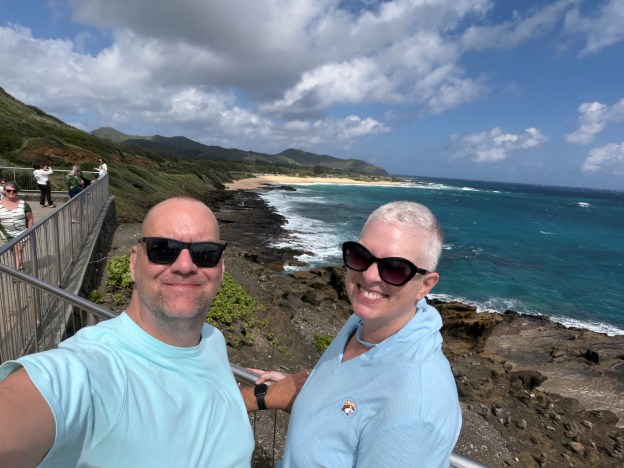
Take Hawaii, for example. My work frequently takes us there.  It is a place that can drain a bank account quickly if you let it. There are helicopter tours, guided excursions, luxury dinners, private charters… all incredible experiences.

And we’ve done some amazing things there. But most days? We’ll grab snorkel gear and head to a public beach. We’ll pack lunch and have a picnic in a park. We’ll hike, swim, or just sit and watch the sunset.

But we don’t see it as deprivation. We do it because we genuinely enjoy it. That’s the key. It isn’t sacrifice if it’s what you actually prefer.

The Hedonic Treadmill

The ChooseFI community talks a lot about the “hedonic treadmill” or  the idea that as your income rises, your expectations rise with it. What once felt luxurious becomes normal. Then insufficient. Then embarrassing.

You upgrade the car. You upgrade the house. You upgrade the vacations. You upgrade the restaurants.

And suddenly your higher income doesn’t make you wealthier.  It just makes you more committed, more stuck in “the middle class trap.”

That treadmill is expensive. Keeping up with the Joneses isn’t just emotionally draining. It’s financially destructive. Our “low coolness threshold” has quietly protected us from that.

We bought an older starter home and didn’t upgrade. We drove used cars for over a decade. We skipped the flashy experiences in favor of the ones that felt meaningful.

Not because we’re anti-fun, but because we actually like simple.

Nature as a Financial Strategy

Here’s what struck me at that conference:

Stopping to smell the roses isn’t just good for your mental health. It might be the key to financial independence.

If you can train yourself (or discover within yourself) that a sunset is as satisfying as a luxury rooftop bar, you’ve unlocked something powerful. If a beach picnic feels just as good as a $200 dinner, you’ve reduced the cost of happiness. If a morning walk in a park competes with an expensive hobby, your savings rate increases without feeling like a sacrifice.

That’s not frugality for its own sake. That’s alignment.

The Bigger Picture

Financial independence doesn’t require monk-like discipline or joyless living.It requires clarity about what actually makes you happy and then intentionally spending on things that actually impact your happiness.

For us, that clarity has been a superpower. A low coolness threshold. 🙂

The world will always try to sell you a more expensive version of enjoyment. Bigger. Better. VIP access.

But sometimes the most profitable thing you can do is sit outside, breathe deeply, and realize you already have enough.

Something’s Got to Give

HNL–LAS–OMA–DAL–BNA–MYR. Six airports. Four days.

Yes, some of those were just connections, but I still ended up sleeping in a different bed four nights out of five. Right now we’re in Dallas for a bridal shower, which meant my presence wasn’t exactly required. So I slipped away to my old pool for a swim, trying to shake off the travel rust.

That’s where I ran into an old friend who looked at me like I’d dropped out of the sky (and I guess I kind of did) “I thought you guys were in a different state! Don’t you get tired of traveling so much?”

I gave her a non-committal answer and turned the conversation back to her and the things that she has going on, but I thought about her question while I was working out. The answer is, unsurprisingly, both yes and no.

Travel is incredible. It brings professional opportunities, new places, and connections with people all over the country. But the instability that comes with it? That part can be exhausting. And yes, I fully recognize the privilege in saying that. Complaining about working in Hawaii and Myrtle Beach, or about driving our old car or having to borrow goggles because my new things is stashed in another state? These are very much first-world problems. Still, when you’re navigating early retirement, these are the kinds of challenges you eventually face.  Even for people not on the FIRE path, there’s a universal question here: how do we choose between competing priorities?

Work. The work of “adulting” we all have to do (Bills, Doctor’s appointments, maintenance of our possessions, etc.). Family and friends. Hobbies. There’s never enough time for everything. And too often, the culture in the U.S. pushes us to put our careers first, no matter what it costs the rest of our lives.

I assumed things would feel different once Katie and I retired. But the truth? We still have to make choices, and we still wrestle with whether they’re the right ones. I’m not immune to “one more year syndrome” — the temptation to take on another contract, another job, another project, especially when the offer comes from a cool place or an organization I’d love to help.

Katie and I are slowly learning how to say no. This year, I stepped away from my adjunct professor role, and she gave up her virtual teaching gig. Those were steps in the right direction. But is it enough? We’ve already talked about limiting how much contract work I take in the future even further, so we can actually enjoy all the fun places we’re trying on for size instead of rushing through them.

So here’s the question I’ll leave you with (whether you’re retired or still deep in the 9-to-5): How do you decide between competing priorities? Do you use a system? A rule of thumb? Gut instinct? I’d love to hear how everyone else navigates the trade-offs in their own lives. Drop a comment below or send me a message.  Your strategies might be exactly what I need or what someone else in this community needs to hear.

How Much Did the First 24 Hours in Omaha Cost?

We’re one full day into our first “slomad” journey and are settling into our new home in Omaha, Nebraska. I get a lot of questions about costs, and, even though we’re renting furnished places, I’ve also been curious about what unexpected expenses might pop up during these moves. So here’s a breakdown of everything we spent in our first 24 hours in Omaha:

Lodging

We pulled into town around noon and moved into our place. It’s a fully furnished, utilities-included two-bedroom apartment right on the edge of the Old Market neighborhood in downtown Omaha. At $1,500 a month, that comes out to about $50 per day of lodging.

Exercise

A couple of blocks away, we checked out the neighborhood YMCA. Our building has a decent workout room, but Katie and I swim a lot and we wanted access to a pool, plus classes and the chance to be social. I bargained away the joining fee by agreeing to pay the first month up front. For both of us, with full access to every YMCA in the region, it’s $75/month—or $2.50 for the first day.

Library

On the way back, we ducked into Omaha’s downtown public library. It was spacious, modern, and definitely a place we’ll return to when we want a work spot outside the apartment. We signed up for cards for $0 and now have access to meeting rooms, printers, copiers, and, of course, endless digital and physical media.

Household Goods & Groceries

Our next trip was to grab some household essentials and groceries. Honestly, I was worried we’d need a lot, but the apartment was remarkably well equipped.  They even gave us starter sets of consumables like paper towels, soap, and laundry detergent. That said, we still picked up a Brita filter, a laundry basket, a drying rack, and a few other upgrades, most of which will stay behind when we move out.

  • Groceries: $52
  • Household odds and ends: $121 → amortized over our stay: $1.15 for day one

Dinner Out

By the time we finished shopping (and skipped lunch), we were starving. Friends had suggested Pizza Ranch, a buffet I was skeptical of until we tried it. Yes, it’s family-friendly, but the food was solid: salad bar, pizza, fried chicken, dessert, the works. Maybe more than we should have eaten, but worth it 🙂  $37 for the two of us.

Free Fun

The next morning, I used the new gym membership, then Katie and I took a long walk around downtown, hung out at a park, and even tried out the public hammocks. Cost? $0

Day One Total: $152.15

So, what did we learn?

  • Furnished rentals can save big money. Filling a place from scratch adds up fast; Furnished Finder has already proven cheaper and easier.
  • Hidden costs still pop up. Even with a well-stocked apartment, there are always “little” things you want—like a water filter or a laundry basket—that need to be budgeted for.
  • Entertainment doesn’t have to cost much. Libraries, parks, and neighborhood walks are free, and they’re going to be a bigger part of our lifestyle as we check out different locations.
  • Life has a baseline cost. A chunk of this spending—food, exercise, even some household items—would have happened whether we were home or traveling.  Too often we look at all travel expenses as additional money out of pocket, but if I am buying groceries here, I am not buying them in Texas.  Even the monthly YMCA expense just replaces a gym membership that we cancelled last week.

When you look at it that way, traveling isn’t necessarily more expensive than staying put. In fact, with the right planning, it can be cheaper and a lot more fun.

Of course this was just day one in Omaha. We’re curious to see how the averages shake out as the days and weeks go on, but so far, the experiment looks promising 🙂