
Although Katie is a big baseball fan and we have been to almost half of the MLB ballparks, over the years, we’ve come to appreciate our trips to see college and minor league baseball more than Major League games for a variety of reasons. Smaller parks are easier to get in and out of. The atmosphere is more intimate. Teams tend to try harder with fan interaction. And, of course, everything is cheaper. Not just tickets, but parking, concessions. etc.. It’s just easier to enjoy.
Which got me thinking: Does that same “smaller is better” idea apply to other experiences? Like zoos?
Big Zoos, Big Experiences
We really enjoy zoos. We’ve been longtime members of the Dallas Zoo, and over the years we’ve visited some of the big names like San Diego, Omaha, Washington DC. and they’re really impressive.
Huge exhibits. Global species. Carefully curated experiences. In some cases, they feel closer to theme parks than traditional zoos. But along with that scale come tradeoffs like crowds, commercialization, and higher prices. And, occasionally, the feeling that you’re moving through an attraction instead of experiencing it. Still fun. Just… different.
A Smaller Alternative
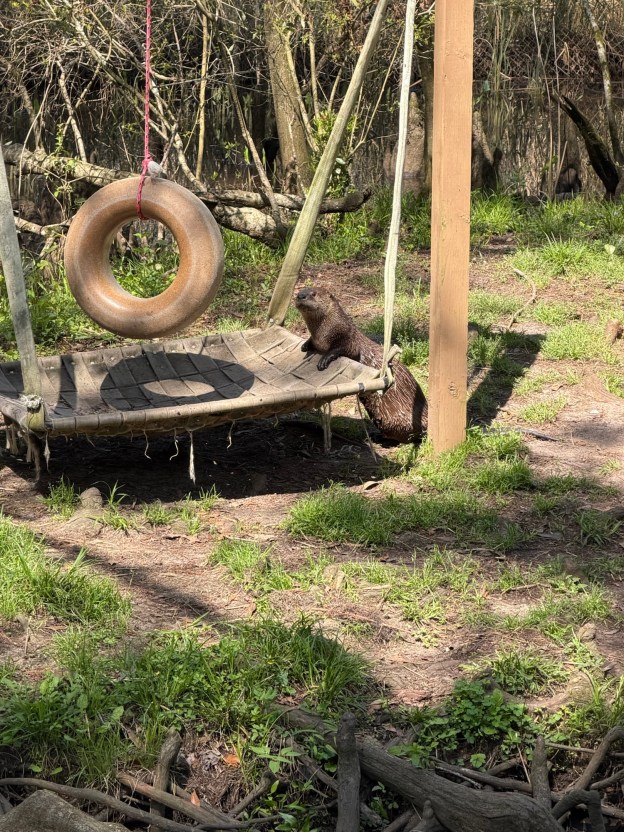
This week, we visited the Lowcountry Zoo just outside Myrtle Beach, tucked inside Brookgreen Gardens. It couldn’t have been more different. The entire zoo is maybe eight or ten exhibits, arranged along about a one-mile loop. You can see everything in a couple of hours without rushing. It was a wonderful experience.
Instead of crowds, there was quiet.
Instead of concrete paths and signage everywhere, there were natural trails winding through native vegetation. Instead of exotic animals flown in from around the world, the focus was on local species…animals that actually belong in that environment.
We weren’t fighting for space at exhibits. Or navigating tour groups or schedules. It was just us, the animals, and the sound of the wind moving through the Loblolly pines. It felt less like visiting an attraction and more like being part of the environment.
Simplicity vs. Spectacle
The smaller zoo didn’t have the scale of San Diego or Omaha.
No rides. No elephants. No massive habitats. No “must-see” headline exhibits. But it had other things like space, time, and calm. And in a way, that made the experience more memorable. This is something we keep running into during our travels.
Bigger, more complex experiences often come with higher costs that can be calculated not just financially, but also in terms of time, energy, and attention. Smaller experiences are often cheaper, less crowded, more relaxed, and sometimes just more enjoyable
Of course that doesn’t mean smaller is always better. It just means simpler is often enough.
The FI Connection
In the financial independence space I hear the phrase “return on hassle” primarily used to talk about investment options, but the idea applies everywhere.
You don’t always need the biggest house, the newest car, or the most expensive vacation Sometimes a smaller, simpler option delivers just as much (or even more) satisfaction at a fraction of the cost. The Lowcountry Zoo wasn’t free, but it was certainly inexpensive compared to major zoos. And more importantly, it didn’t feel like we were sacrificing anything. That’s the sweet spot.
A Both/And World
To be clear, we’re not giving up on big zoos. Now that the pandas have returned to the San Diego Zoo, I am sure we will make a point to go back at some point. There’s something exciting about the scale, the energy, and even the crowds.
But I’ve come to appreciate that smaller, local places have their own kind of charm with less spectacle and more connection. And sometimes, that’s exactly what you need. Sometimes the biggest upgrade isn’t going bigger, but going simpler.
Your Turn
What about you? Have you found areas in your life where smaller ended up being better? Not just cheaper, but genuinely more enjoyable?
Discover more from Early Exit, Open Road
Subscribe to get the latest posts sent to your email.
