Author Archives: earlyexitopenroad

Myrtle Beach!

Well, we have landed here in Myrtle Beach. It was a long journey as we left Dallas the day after a red-eye from Honolulu. Eric had to work in Honolulu AND be here to work so we didn’t have a lot of time to rest between travel legs.

The weather is a little cold BUT it is warming up. We knew February would still be winter so prepared accordingly. I am glad that I have been here a couple of times over the past six months so it wouldn’t be 100% new to me. We are settling in slowly as Eric has been working the past two days and I have been unpacking and organizing our space.

This will be the smallest place we have ever lived in. It is a hotel/condo on the beach and it truly has everything we need. However, we have just never lived in a small space like this before. Our place in Omaha was the smallest we had ever lived in prior to this but it is probably 1.5x bigger than this.

We bought some additional shelving and that has made all the difference! It almost makes me think that we could live like this for longer than three months. You all know that I really just love being right on the water. It is just so therapeutic for me.

Follow us on our social media to see what our place actually looks like, and also to see the view from our balcony! https://linktr.ee/earlyexitopenroad

Thanks for being here with us!

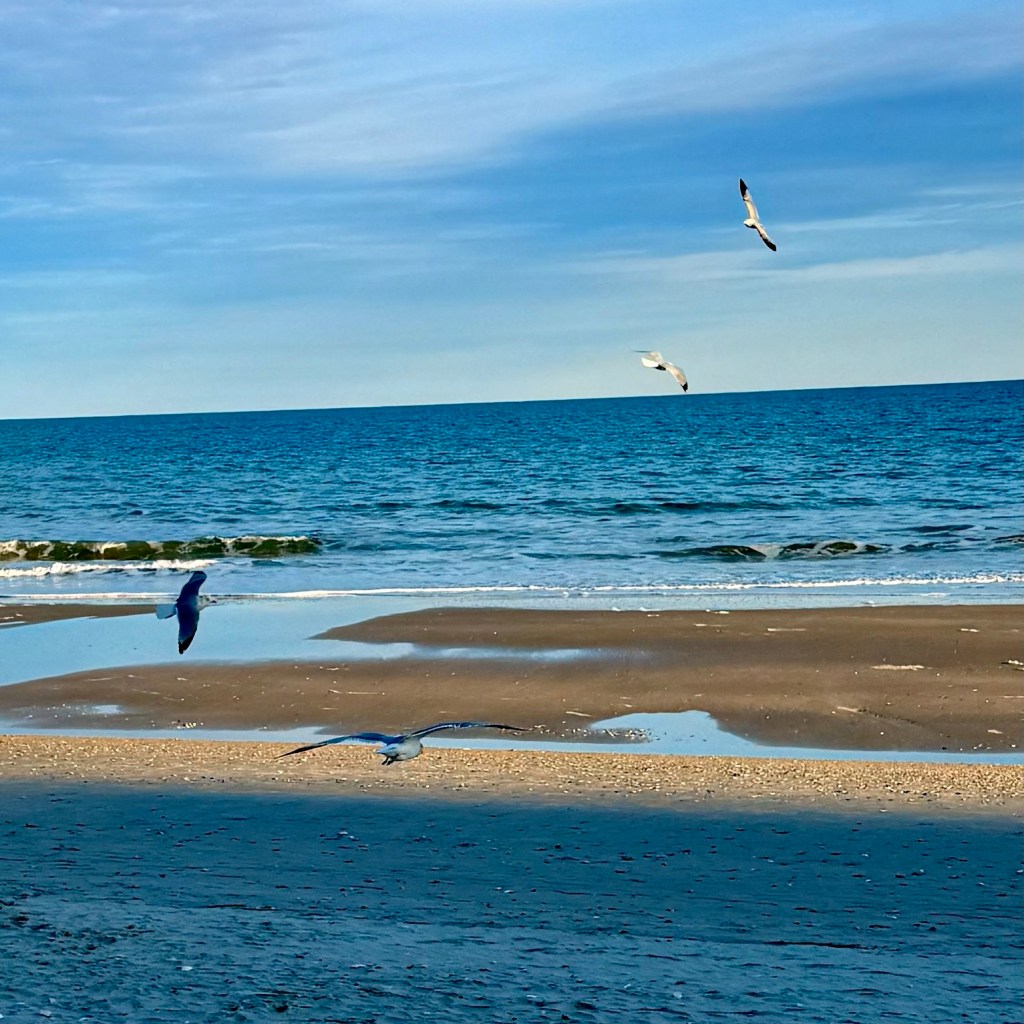
Love watching the various seabirds!

How Do You Pack for Months Away from Home?

3 Feb 2026 This post was written last fall. We are now preparing to do it again this week when we move to Myrtle Beach!

When we started planning this nomadic adventure, the question came up: How on earth do you pack for months away from home?

Surprisingly, it’s not that different from how I pack for a week-long business trip… at least in some categories. After all, laundry and Amazon delivery still exist in other states. And, if I’m honest, even when I’m home for months at a time, I usually catch myself wearing the same rotation of clothes over and over… the ones that are rewashed and put back on the top of the pile.  Here’s how it breaks down.

The Almost-the-Same Stuff

Clothes
My “packing for months” wardrobe looks a lot like my “packing for a week” wardrobe, just with a few extras to account for different weather. If it works in July, I throw in a hoodie for October. Done.  (In some places those of us who are 6’7” and 270 lbs have to be careful because there isn’t a ready market for extended size clothes if we need to buy something in a pinch, but in Omaha? I think I will be OK) 

Katie says: I bring my big pink suitcase, Bertha, that I usually bring to Hawaii. It holds my clothes, swimsuits, snorkels, water shoes, sunscreen and the like. I also bring the medium and small pink suitcases and a blue one as well. Also some duffle bags. I have to have SOME variety in my clothes!

Technology
I’ve already got my go-to travel tech bag: laptop, chargers, cables, noise-canceling headphones (for planes), bone conduction headphones (for everything else). The one new addition for this trip? A green screen backdrop. I bought it during COVID for working from home, and it’s been a lifesaver for quick, professional-looking Zoom calls, no matter what shenanigans are happening behind me.

Katie says: I pretty much do the same thing. I have a travel monitor as well as some tech stuff for my cameras.

Entertainment
Sure, most of our fun will come from exploring new places, but I’m also bringing a hard drive full of movies to go along with our subscription services.  Over the years, I have converted most of my books to digital, so my library lives on my phone already. It was a little sad selling my physical fiction collection to Half Price Books for pennies on the dollar, but at least my professional library found a good home.

Katie says: I brought coloring stuff to Nebraska but did not use it. I found myself taking pictures all the time and then editing those so I could share them with the world. I also had lunch with my cousin Scott if Eric was working. One thing about Omaha was that the entertainment was RIGHT THERE!

The Pretty-Different Stuff

Recreation
Katie and I love stand-up paddle boarding, so earlier this year we swapped our DFW paddle club membership (which we loved) for a couple of inflatable boards. They’re coming with us. We also swim for workouts, so our swim bags—goggles, suits, fins—are on the list. Omaha has a few good lap-swimming spots I’ve already scoped out.

Home Comforts
We’re renting furnished places, so we don’t need to bring much, but a few things made the cut: pillows (Katie is picky, and I like extras), our own sheets (because why not?), and our refrigerator magnet collection. We’ve been collecting these on road trips for years, they pack easily, and they’ll make any kitchen feel like ours. One splurge item: our countertop ice machine. I’ve gotten way too used to having perfect ice for my daily diet sodas.

Katie says: This really made us feel like we had a little bit of home with us. Plus we used our Roku and all of the Backdrops on there are the ones we had at home so that made my heart happy.

Consumables
We’re not loading up the car like a Costco delivery truck, but we will bring a box of some bulk items we already own and don’t want to rebuy immediately, plus some brands that might be harder to find.

Final Thoughts

Packing for months of nomadic travel sounds intimidating, but when you break it down, it’s not much different from a long vacation. Clothes, tech, and a few comforts from home—plus the paddle boards. Always the paddle boards.

How Long Did It Take Two Teachers to Retire Early?

If you’ve ever read the classic Mr. Money Mustache post, The Shockingly Simple Math Behind Early Retirement, you know that the key to retiring early isn’t about your job title or how many zeros are in your paycheck. It’s about how much you spend and how much you can save.  That idea, along with the principles I picked up from podcasts like ChooseFI,  was a game-changer for us.  Before joining the FI community we were saving without any real plan other than the vague concept of having options later in life.

As two public school educators with average salaries and more than a few life detours, we’re not exactly the prototype for early retirement. But here we are… Two teachers who reached financial independence in about 20 years.  Here’s how we did it (without turning our lives into a never-ending death march of deprivation).

It’s Not What You Earn — It’s What You Keep

When we first got serious about financial independence, we were both around 30, starting our second marriages and essentially starting over, financially speaking.

We were also raising two kids, paying for a house, buying reliable cars, earning advanced degrees, and yes — going on vacations. Our life didn’t look “lean” from the outside. But behind the scenes, we were saving 20–30% of our income in most years.  That savings rate, not our salaries, was the real magic.  We figured: if some of our friends were raising families on a single teacher income, surely we could live on 1.75 incomes and still stash some away. 

No Steady March to FI Here

Although I might have, personally, been willing to deprive myself to walk the path to financial independence faster, Katie balanced us out and made sure that we weren’t going to “grind it out” for 10-15 years just to have the vague hope of a better life at the end.  As always, listening to Katie makes things better (OK, I put that in just in case she reads this post).

We weren’t minimalist saints.  We had busy lives, two kids, big expenses (house, cars, advanced degrees, and vacations).  We were intentional, though, making choices (I don’t call them sacrifices) on things we just didn’t value that much.   Some of the things we willingly opted out of included:

  • A fancy home – we never upgraded from our initial “starter” home.  No long commute from the shiny new suburb with the huge houses.
  • Cars – we bought newer used cars and drove them until they died.  No point in having a nice car parked in a high school parking lot 🙂
  • Super expensive kids activities – No taxi parenting or  “travel ball” for us.  Each kid got one regular sport and one other activity at a time. 
  • No luxury vacations – we did road trips and stayed in budget hotels near our vacation spots (until we learned more about travel rewards)

We also took some intentional detours along the way. There were years where one or both of us stepped away from our W-2 jobs.  Sometimes this was for side opportunities, sometimes to escape a toxic campus situation, sometimes just for a break.  Those pauses refueled us, and only slowed the long-term plan slightly.

The Side Hustle Strategy

You don’t have to sell organs or become a TikTok influencer to boost your teacher salary. We took a more grounded approach:

  • On-campus work: summer school, picking up extra classes, coaching, refereeing basketball games, etc.
  • Off-campus work: proctoring SAT and teacher certification exams, tutoring, teaching online, consulting, etc.

Our general rule of thumb on side gigs was simple:

Half of the side income went into the “family pot” — for vacations, kid expenses, or special treats. The other half was ours to spend individually.

That’s how I cash-flowed a doctorate. It’s how Katie built a tutoring side business she genuinely enjoyed (most of the time).  And it’s how we stayed sane while still progressing toward our FI goals on educator salaries.  Not every side hustle paid well, but many brought benefits beyond money: travel opportunities, new friends, professional growth, etc.

What Teaching Gave Us (Besides a Paycheck)

Look, teaching isn’t a high-paying career. We knew that going in. But it gave us something else: schedule flexibility, a deep understanding of systems, and the ability to self-educate.

Those last two? They’re superpowers for anyone chasing financial independence. The problem is that far too many educators don’t use them when it comes to their own lives.  But if you can deconstruct standards, explain algebra to a room of teenagers, or differentiate instruction on the fly… you can understand your 403(b) and plan a savings strategy. And if you can manage a time schedule of teaching, grading, and lesson planning, then you can learn about personal finance and manage your budget too.

The Bottom Line

It took us 20 years, with a few setbacks, some big expenses, and plenty of real life in between but we made it. We hit financial independence as two average-paid teachers with kids, bills, and all the complexity life brings.

The secret? It wasn’t really a secret at all:

  • Learn as you go.  Personal finance is not magic
  • Keep your savings rate as high as you can
  • Spend intentionally on the things that matter to you.
  • Say yes to side income and no to lifestyle creep
  • And remember: early retirement isn’t a finish line.  It’s a launching pad!

Want to know what early retirement actually looks like for us after leaving education? Or why we chose to slow travel instead of putting down roots right away? Stay tuned — we’ve got more stories to share.

Stuff: The Other Four-Letter Word

We’ve lived in our current home for twenty years. That’s two decades of books, birthday gifts, holidays, hobbies that didn’t stick, and random purchases that “might” come in handy… someday. Katie insists that compared to many of our friends, we’re practically minimalists—either because I’m too cheap to buy things in the first place or because I lack any sense of style when it comes to decorating.  If you know me, you know it’s probably both 🙂 

Still, two decades in one place adds up for anyone. And when you have a house, you have room to let things pile up. As George Carlin famously said, “A house is just a place to keep your stuff.” He had other words for stuff, but you get the idea. Now that we’re planning a life without a permanent house, we’ve had to confront a scary truth: something has to be done with all this “stuff.”

There are a lot of popular theories on the best way to downsize:

  • The Marie Kondo method: Does it bring you joy? (Spoiler: most of my stuff just brings me confusion.  What if I go back to a job I last held 15 years ago?  I might really want that…)
  • The one-year rule: If you haven’t used or worn it in the past year, it’s out.
  • The Storage Bin Challenge (my personal, unpopular idea): Everyone gets one big bin to keep items they value.  No-questions-asked. Then we swap rooms and decide what’s valuable in each other’s piles and throw EVERYTHING else away. This, I argue, removes the emotional attachment and speeds up the process. The family disagrees. Strongly.
  • The fire test: If the house burned down, would I pay to replace this?
  • If you didn’t think the fire test was dark enough: If I passed away, would the person cleaning out my house find any value in this?

For now, we don’t have to actually decide on everything. We’re keeping the house for our first year of nomadic travel, partly as a home base and partly as a very expensive storage unit. But just prepping for our older son to rent it this year has forced some tough decisions and a lot of trips to Half Price Books and the donation center.

So, what works for you? If you’ve downsized, what’s your secret weapon for letting go of stuff? Because one thing’s for sure—if this slow-travel adventure works out, we’ll need to learn the art of living with less.

Why Omaha? Did You Lose a Bet?

When we told friends and family that our first “test drive” city for our slow-travel experiment was Omaha, Nebraska, we got a lot of raised eyebrows. Some people laughed. One person even asked me if we had lost a bet.  But the truth is, there are a lot of reasons to like Nebraska, and Omaha in particular.

First, although Katie has some family here and I have worked in the area off and on over the past couple of years, this corner of the country is still fairly new territory for us.  We’ve been to all 50 states on short trips, but we’ve never really dug into this part of the Midwest. That makes Omaha a perfect launchpad for road trips to underexplored places like Kansas City (hello, BBQ), the quirky roadside attractions of Iowa, and even the wide-open spaces of western Nebraska and South Dakota.

Second, the cost of living here is refreshingly low compared to what we’re used to in the Dallas area. For less than the monthly cost of our paid off suburban home, we can rent a two-story, furnished apartment in the heart of Omaha’s Old Market district—utilities included. This historic neighborhood is a mix of brick streets, art galleries, and local restaurants.  For our Texas friends, the best comparison I can think of is the Stockyards area in Fort Worth.   Plus it’s walkable to parks, shops, and even riverfront trails. That walkability matters, especially since we’re going to be sharing one car during our stay.

Third, Omaha has some surprises up its sleeve. There’s a thriving restaurant scene, one of the top-ranked zoos in the country, and because it is the largest city in hundreds of miles in any direction, a pretty  impressive live music and theater lineup.  Add in friendly Midwestern hospitality, and you’ve got a place that we think will be easy to settle into, even for just the fall semester.

Of course, the real reason we’re here is that this is just stop number one in our search for a “forever home.” We don’t know yet if Omaha will be the winner, but that’s the fun of slow travel.  We get to try on different lifestyles and locations for size. For now, we’re keeping an open mind and enjoying the adventure.

Why Are We Slow Traveling the U.S.?

One of our family goals was to get both boys to all 50 states before they were out of the house.  Sadly, circumstances (Link to other article) left Katie the boys stuck at Forty-nine.  That is still an accomplishment, but instead of scratching that off our list and settling into a “normal” retirement routine now that the kids are grown, we’ve decided to hit the road again— just a little differently this time.  We’re not tourists anymore.  Now we’re test-drivers. 

Texas has been great for us.  We got degrees, raised a family, had careers here.  It has never really felt like home to Katie, though.  And just because we live here now, that doesn’t mean we have to live here forever.  Maybe we will want our forever home to be in a cooler climate, so we don’t have to hide in the AC for 4-5 months a year?  Maybe we want actual elevation changes?  Trees?  Maybe fewer extremes… in weather and in political climate? 😊

Wait, You’re Not Traveling Internationally?

Nope — not yet.

Sure.  My FIRE people, the travel blogs, Instagram reels… everyone seems to be sipping espresso in Italy or eating $1 pho in Vietnam. And with Katie being a fluent Spanish speaker (and me speaking like at least a third grader), Central and South America seem like a natural fit.   We’re all for exploring those options… eventually. But for now, we’ve made a conscious choice to look domestically. Why?

1. Consulting work – I’m still doing some consulting, and it’s just easier to manage from within the U.S.  Travel, time zones, Zoom calls, internet reliability — it’s not glamorous, but it’s real life and it helps fund the adventure and minimize sequence of returns risk at the start of our early retirement.

2. Scouting our “forever home” – We don’t just want to travel for the sake of movement. We’re on a mission. We’ve done the tourist version of all 50 states, but now we want to live in them — or at least in some of the top contenders.

3. Logistical simplicity – No visas, no long-haul flights, no currency exchanges, and no language barriers. Plus, we can bring more stuff, cook in our own kitchen, and drive our own (new) car along the way.

Why 2–4 Month Stints?

At this point we think that staying at least two months is going to be our sweet spot.  Both of us have travelled a lot for short trips for vacation or business.  That wasn’t enough for a real look at different areas, though.

Month one is for figuring things out — Where the best grocery store is, how the weather really feels, can Katie get decent Mexican food, and how far the walking trails are from home.

Month two (and more) is when we settle in and get to know the rhythms. We will notice things like traffic patterns, neighborhood personalities, and whether the town actually has a good community feel or just good PR.

What We’re Looking For in a Home Base

We’re not just looking for postcard beauty or an affordable zip code (though those don’t hurt).  We’re looking for:

·   – A manageable cost of living

·   – Mild-to-moderate seasons

·   – A sense of community

·   – Access to nature without being hours from an airport with good connections

·   – Solid healthcare options

·   – Bonus points for walkability, water access, and a good public library system

The Unsexy Side of Domestic Slow Travel

Is it always going to be dreamy? Of course not!

Finding decent mid-term rentals has been tricky, especially with the rise of AirBnb fees (Link) and leases that either want a weekend stay or a full year commitment. We’ve had to get creative using furnishedfinder.com, Facebook groups, and even reaching out directly to landlords.

We also have to be careful not to just “vacation” our way through this. This isn’t about tourist attractions, restaurants, and photo opportunities.  It’s about real-life living — doing laundry, getting oil changes, finding the nearest urgent care.

And honestly, there’s going to be some emotional fatigue in packing up and starting over every few months. It will be especially problematic this Fall when my consulting schedule is a lot heavier than we had originally planned.  But we will balance it with some slow days, outdoor time, and the occasional indulgence.

What’s Next?

We’ve got a few areas on the shortlist already, largely based on my work schedule.  Omaha, Myrtle Beach, Seattle, etc.  Eventually, we might dip our toes into international waters. But for now, we’re looking forward to roaming America’s backroads, main streets, and regional gas station chains — one stay at a time.  And who knows? Maybe the next stop will end up feeling like home.